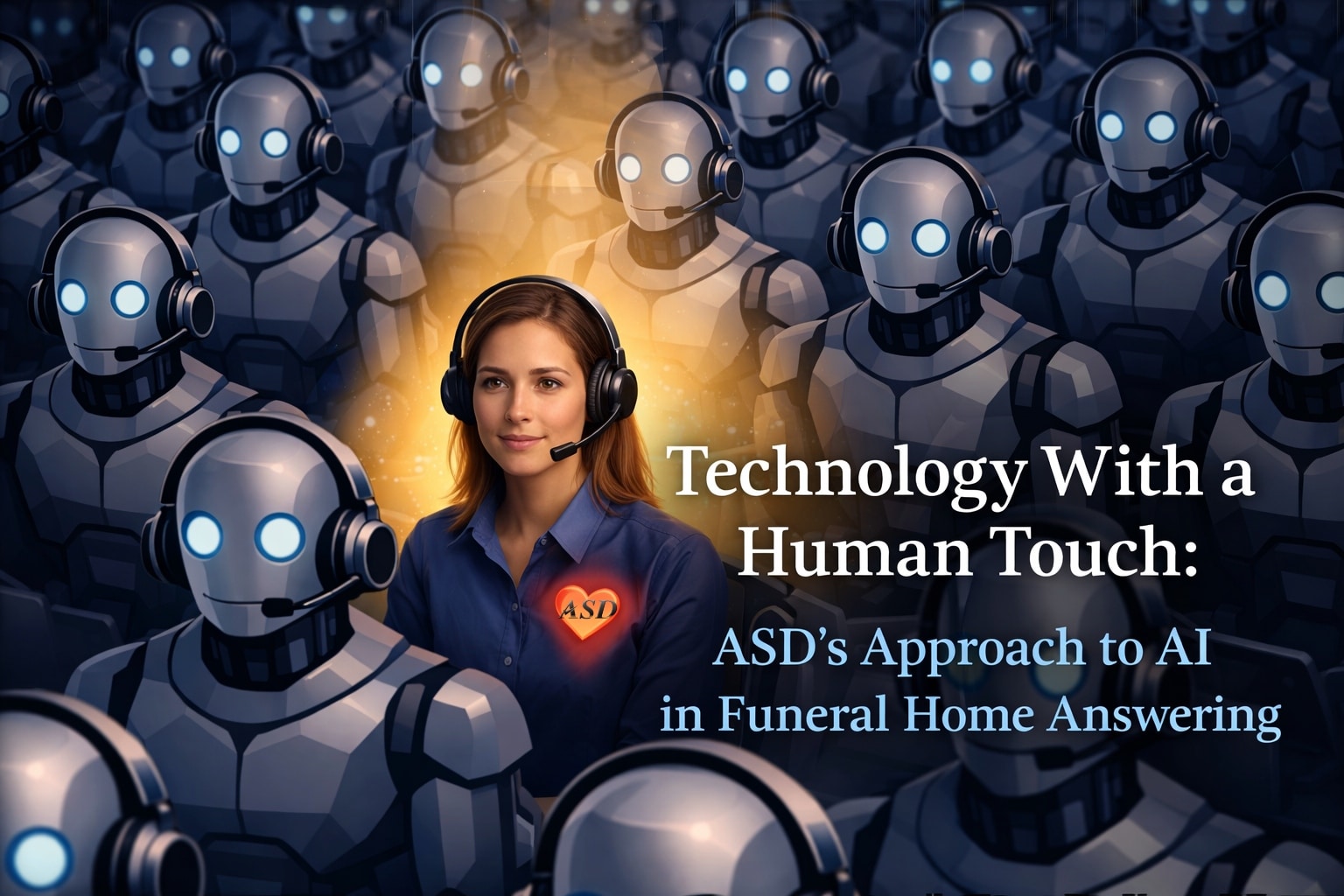
In an era where artificial intelligence is rapidly reshaping customer service, funeral home communication requires a different kind of care. At ASD, we believe AI in funeral home answering should enhance the work behind the scenes—not replace the personal connection families depend on during life’s most difficult moments. That will always be our philosophy here at ASD as it is for the funeral homes that are trusted most by their community.
There is no denying that AI can streamline many processes and can unquestionably improve operations at funeral homes. The same is true for our answering service. In recent years, we have utilized AI solutions to strengthen areas like quality assurance monitoring and message accuracy. However, lately we keep getting hit with the same question repeatedly—what does AI mean for call centers like ASD? In this post, we’ll explain why AI isn’t something we fear—it’s something we use thoughtfully. Learn how we balance innovative technology with compassion and why a real, empathetic voice will always remain at the heart of funeral home answering.
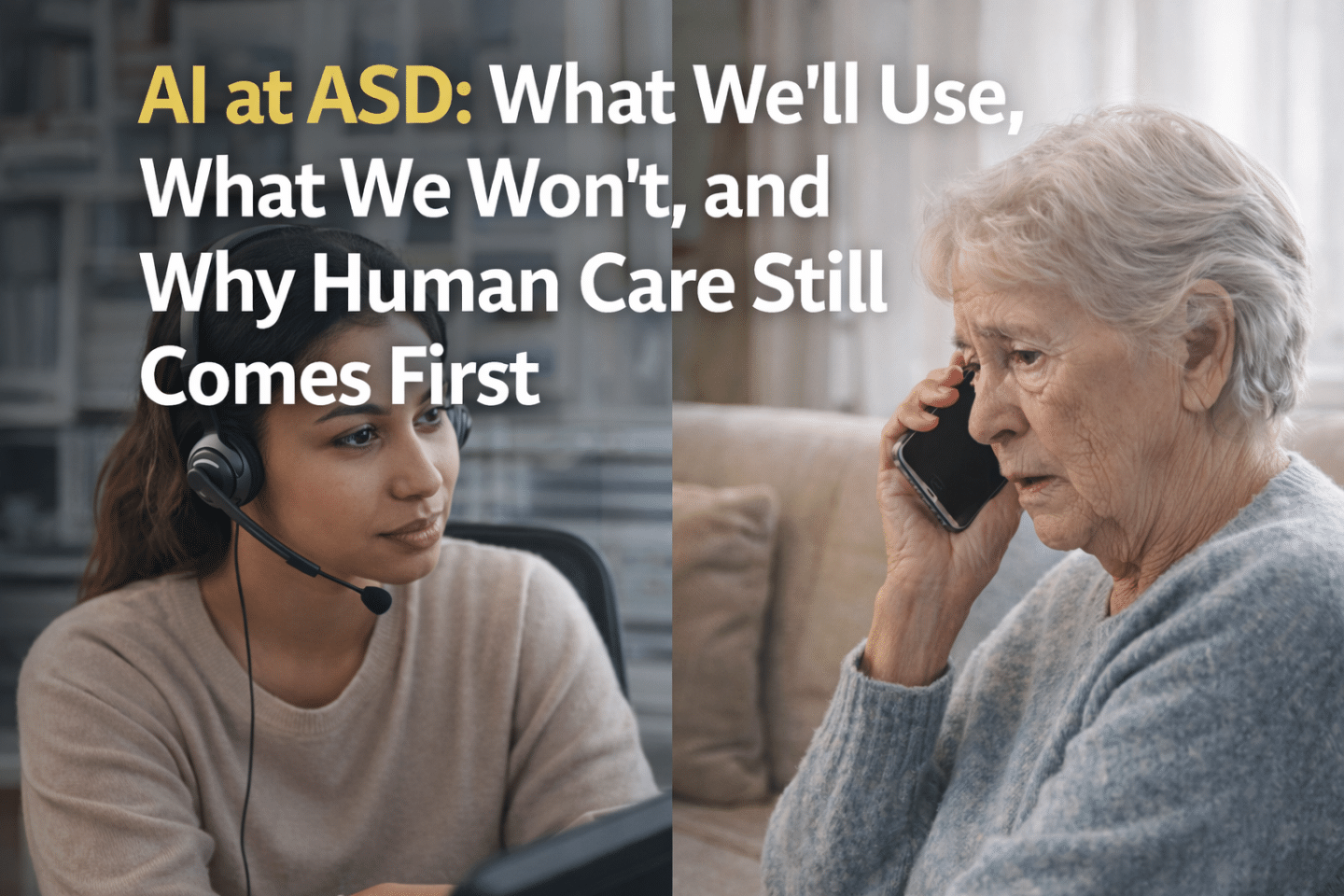
3 Ways ASD Uses AI
1. Transcriptions for Clients and Staff
Our company’s first foray into AI began with the introduction of automatic message transcriptions. This enhancement to ASD’s service—offered to every client at no additional cost—allows funeral home staff to instantly review, search, and document sensitive conversations through the ASD Mobile app or website. By automatically transcribing messages, funeral homes gain a searchable, written record of every conversation ASD handles on their behalf. Message transcriptions also support ASD staff by serving as a helpful reference while taking messages. With the dialogue displayed live throughout each call, Call Specialists can focus more fully on listening, resulting in greater accuracy and attention to detail.
2. Voice Cloning
For many years, ASD has used what we call our “Perfect Answer” system to greet callers. This automated introduction, selected by each funeral home, plays at the beginning of every call. Traditionally, the introduction was recorded by several Call Specialists using different voices and then matched to the rest of our team. This approach ensured the funeral home’s name was always pronounced correctly and gave the Call Specialist a moment to review the account before speaking with the caller.
While we called it the Perfect Answer, the truth is it wasn’t always perfect. Callers would sometimes ask, “Is this a machine or a person?” at the start of a call.
Ironically, it’s AI that’s now helping us make the experience feel less robotic and more human. Our new system uses recordings from each Call Specialist’s actual calls to create a personalized introduction that matches their natural vocal inflection. This voice cloning process ensures that when the Call Specialist comes on the line, their voice sounds identical to the automatic greeting—creating a seamless, natural transition and a more reassuring experience for callers.
3. Quality Control Internal Screening
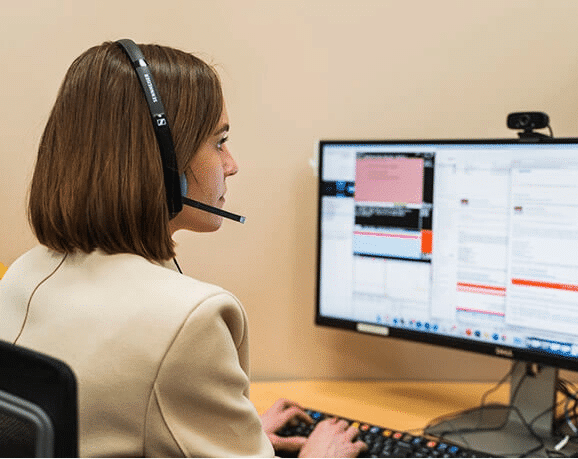
One of the most beneficial uses we have found for AI is how we use it behind the scenes for quality control. While ASD has always relied on internal screening measures to regularly evaluate our staff’s performance, AI enhances this process by automatically scanning call recordings for unprofessional background noise and flagging any words or phrases that may be deemed unacceptable.
We pride ourselves on having the most highly trained, compassionate Call Specialists in the profession, and the fact that every call is recorded has long been central to our commitment to accountability and transparency. This added layer of AI-driven monitoring strengthens that commitment even further, allowing us to identify potential issues more quickly and consistently. The result is an even higher standard of service—and the assurance that no call falling short of our expectations ever goes unaddressed.

Where AI Falls Short: Live Answering
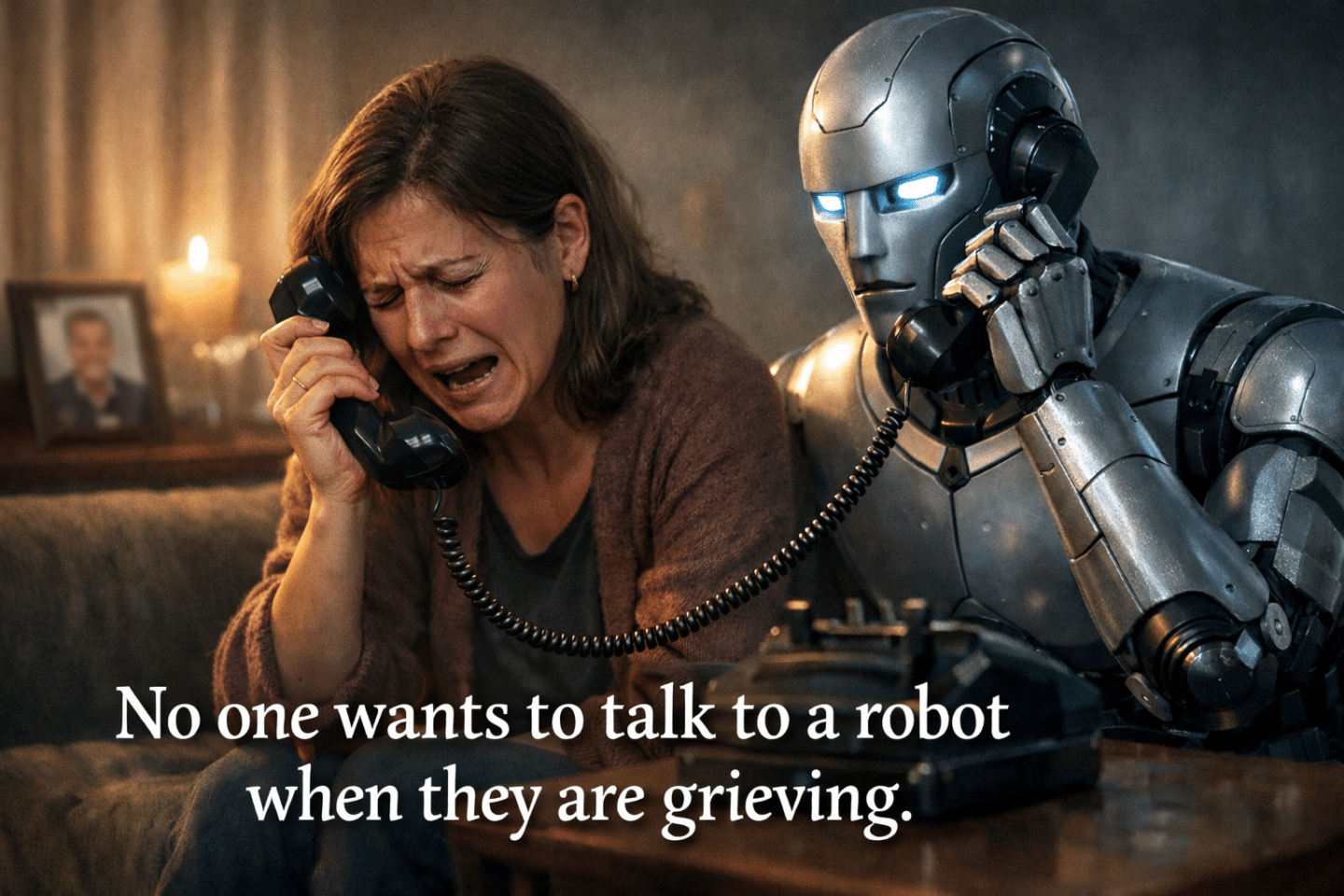
We’ll be the first to acknowledge that technology has its place, but not on your first call. When compassion counts, AI simply falls short. There is no substitution for a genuine human being when it comes to funeral home communication. Recently, we have heard of several new solutions being introduced that utilize automated telephone agents for funeral home phone calls and find the trend to be rather troubling. If you are considering using one of these new AI solutions for your funeral home’s sensitive phone calls, we urge you to reconsider. Here’s why:
5 Reasons Not To Use AI in Funeral Home Answering
1. Brand Damage
Your funeral home’s reputation hinges on trust and compassion. A robotic or scripted interaction could alienate families at the most vulnerable moment in their lives. A human answering the phone can build rapport, answer sensitive questions with care, and begin the relationship-building process right away—critical for client families. On the other hand, an AI call agent could cause a family to change their mind and call a different funeral home, resulting in lost business and a tarnished reputation. These funeral AI concerns can cause major damage to your brand. You may think, “it’s just one phone call, I will handle things myself after the AI system vets the caller.” However, the first call sets the tone for the entire funeral experience. Do you really want that moment to be handled by a robot?
One of the reasons some businesses have chosen to use AI to answer their phone is to avoid situations where a caller may be placed on hold or sent to voicemail. That concern is valid if you are answering all calls yourself or relying on an unreliable answering service. However, funeral homes that partner with ASD never have to choose between using AI call agents or having a family waiting on hold. Our systems and staffing model are built specifically to ensure calls are answered without delay. In fact, more than 90% of calls to ASD are answered on the first ring, and fewer than 4% of callers are ever placed on hold for any length of time. Families are greeted immediately by a trained, empathetic Call Specialist—ensuring every first call is handled by a real human when it matters most.
2. Lack of Emotional Intelligence
The most important thing to consider when it comes to deciding who trust with your firm’s sensitive calls is the experience those calling your funeral home will have when they reach out in their time of need. The fact is, AI can’t genuinely express empathy. Families in grief often need comfort, not just information. There are some many complex emotions involved during these conversations. Bereaved callers may be angry, confused, overwhelmed, or tearful. A trained human can adjust tone, listen patiently, and offer supportive reassurance. AI simply can’t navigate those nuances. Ignoring these glaring funeral AI concerns may be detrimental for your business.
3. Failure to Adapt Mid-Call
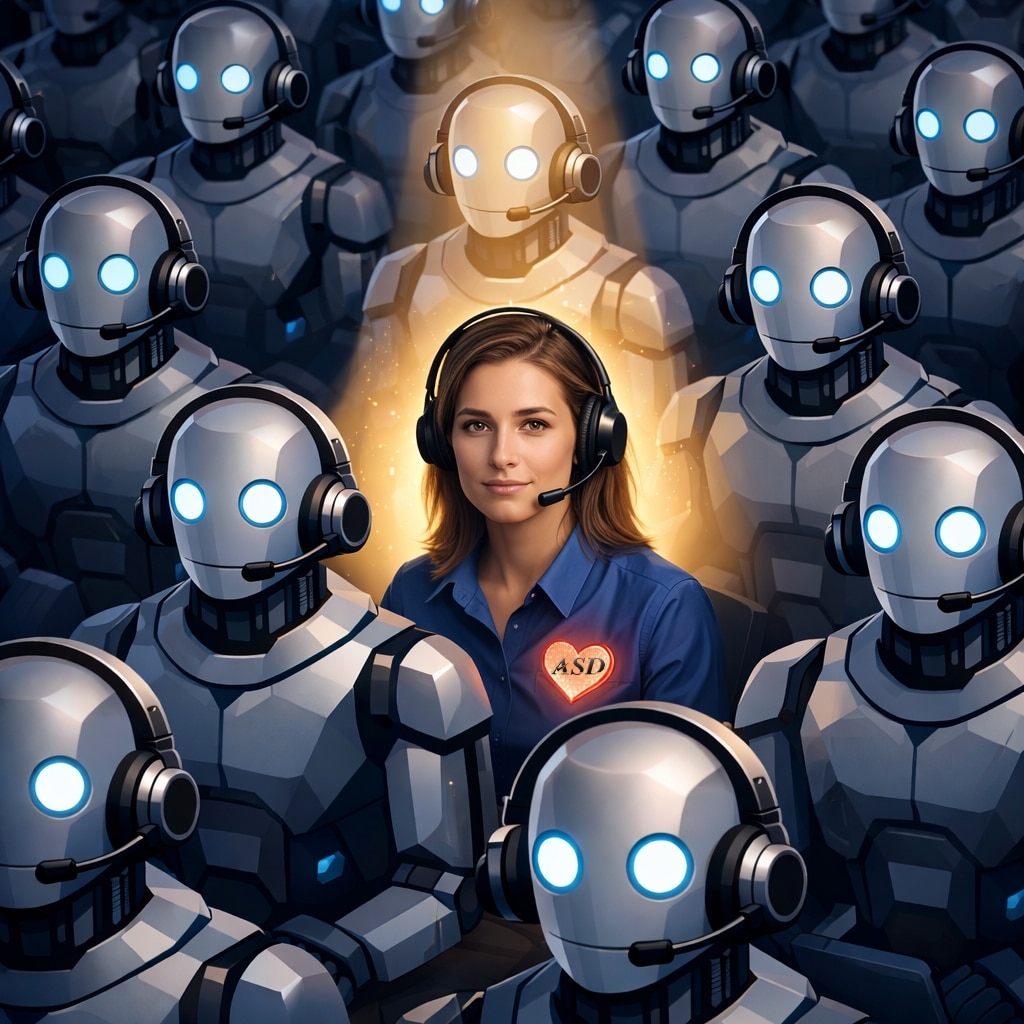
A skilled human can shift tone, change direction, or prioritize based on what they hear. AI agents follow scripts and pre-coded responses, which can make the conversation feel mechanical or insensitive. There are some many unique situations that can arise when a family calls a funeral home. For instance, first calls may involve non-standard requests, specific needs, or family dynamics that AI agents aren’t equipped to handle without errors or awkward missteps.
ASD Call Specialists are trained extensively on how to respond appropriately to a wide range of emotional and complex scenarios. They understand how to convey empathy, gather accurate information, and adjust their communication style depending on the caller’s tone and urgency. Unlike AI, which may misinterpret emotional cues or fail to adapt in real time, ASD Call Specialists can recognize when a caller is grieving, confused, or under stress—and respond with the care and professionalism those moments demand.
4. Risk of Misunderstandings
Speech recognition can falter with accents, background noise, or emotionally distressed voices—leading to mistakes that no funeral director can afford. There are some many ways that a miscommunication can occur when using AI in funeral home answering. Many people aren’t familiar with jargon associated with the funeral profession and could easily say something that the AI misunderstands or fails to process appropriately. Names of funeral homes, cemeteries, or even common terms like “viewing” and “visitation” can be misheard or misinterpreted. In a profession where clarity and compassion are paramount, even a minor error can lead to a major loss of trust—making human understanding and context not just helpful, but essential.
5. Ethical Considerations
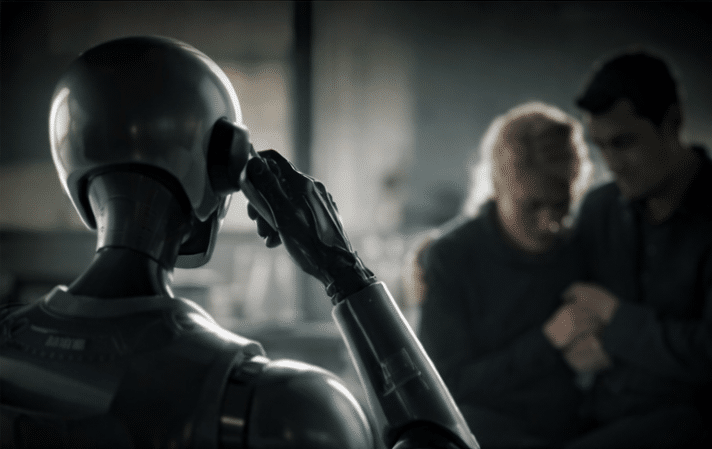
There’s something inherently cold and impersonal about letting AI handle a death notification or family’s first call after a loss. It just feels wrong on many levels. All of us have endured difficult automated exchanges when reaching out to healthcare organizations. While this has become somewhat normalized, most would agree these exchanges make one feel like a number instead of a person. With a funeral home, those reactions are amplified tenfold. Families reaching out after a death are in a uniquely vulnerable state, and any sense of being dismissed, misunderstood, or processed by a machine can deepen their grief.
The Only Exception
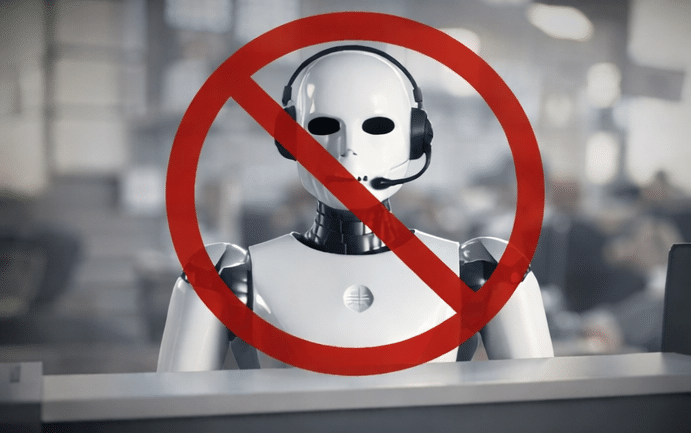
Funeral homes operate in many different ways, often shaped by their communities, business models, and the needs of the families they serve. For some, affordability is a primary focus, and that approach can influence how after-hours communication is handled. While our philosophy has always centered on live, compassionate answering, we recognize that some funeral homes may be exploring AI-based solutions as a more economical option. Our role has never been to judge, but to support funeral homes wherever they are in their journey. That’s why we continue to explore ways to offer alternative solutions for firms that specifically request them.
When you consider that some funeral homes still rely on voicemail or have no online presence at all, having some form of after-hours response in place can be a meaningful step forward for families seeking information. This is the one area where we see a limited exception to our belief that AI should not replace human answering in funeral service. In certain situations, an automated solution may provide a practical starting point—while still leaving room to grow toward more personalized service in the future
Final Thoughts
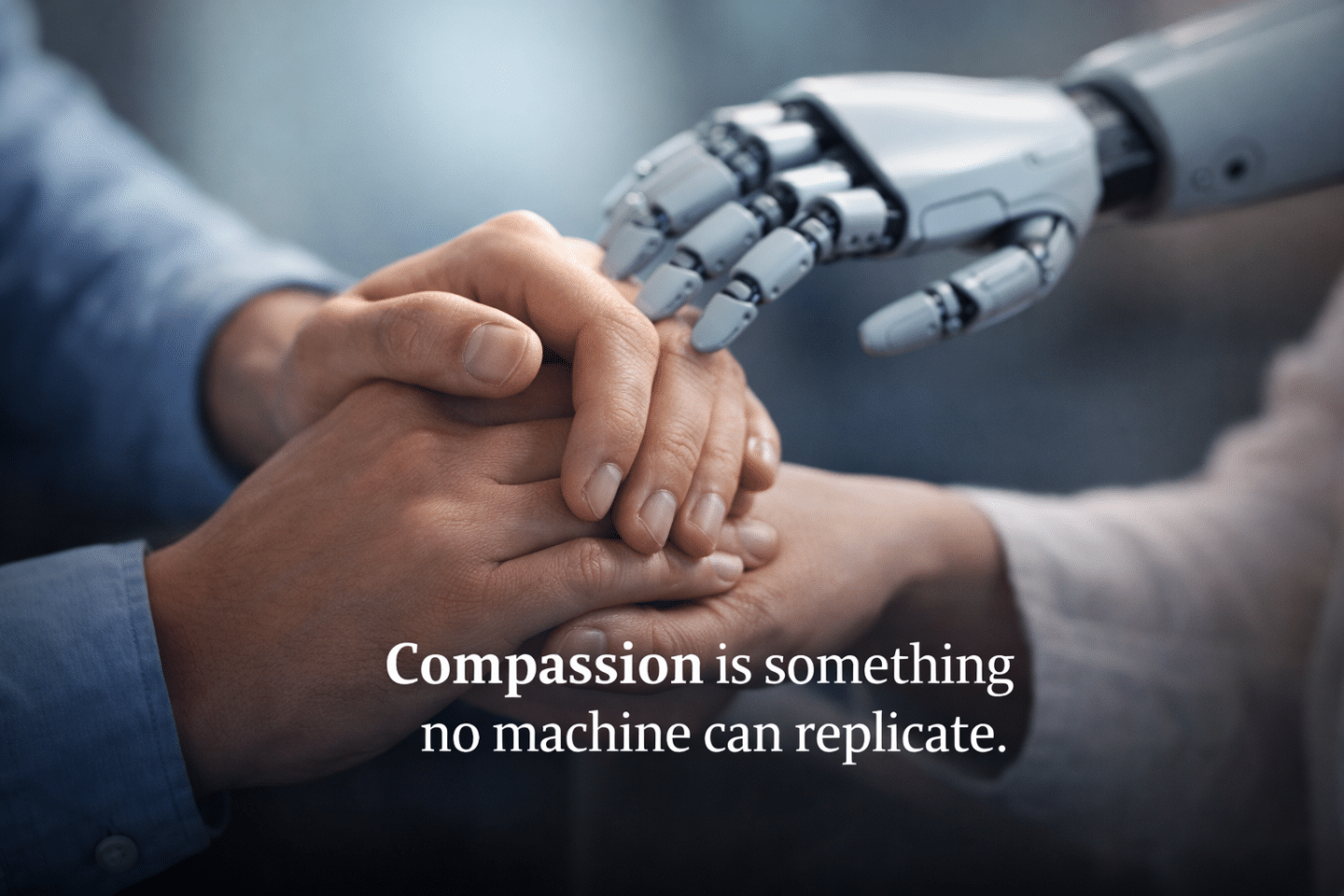
In this profession, it is critical that new technology support, not replace, the compassionate human touch that is the cornerstone of funeral service. AI might be efficient, but families aren’t looking for efficiency in those moments—they’re looking for someone who cares. If you’re looking for ways to streamline operations at your funeral home, there are many technology companies offering automatic solutions that can help you save time. Whether you use AI to help write obituaries or organize paperwork, it’s important to remember that it can never substitute authentic human interaction. However, there really is no place for AI in funeral home answering. Sacrificing sensitivity for efficiency is a risky trade-off—especially in funeral service, where compassion, presence, and empathy matter more than speed or automation.
Related Reading
ASD Empowers Funeral Homes with Automatic Message Transcriptions
7 ASD Features that Matter Most to Your Funeral Home Callers
Fall 2025 Highlights: What’s New at ASD